
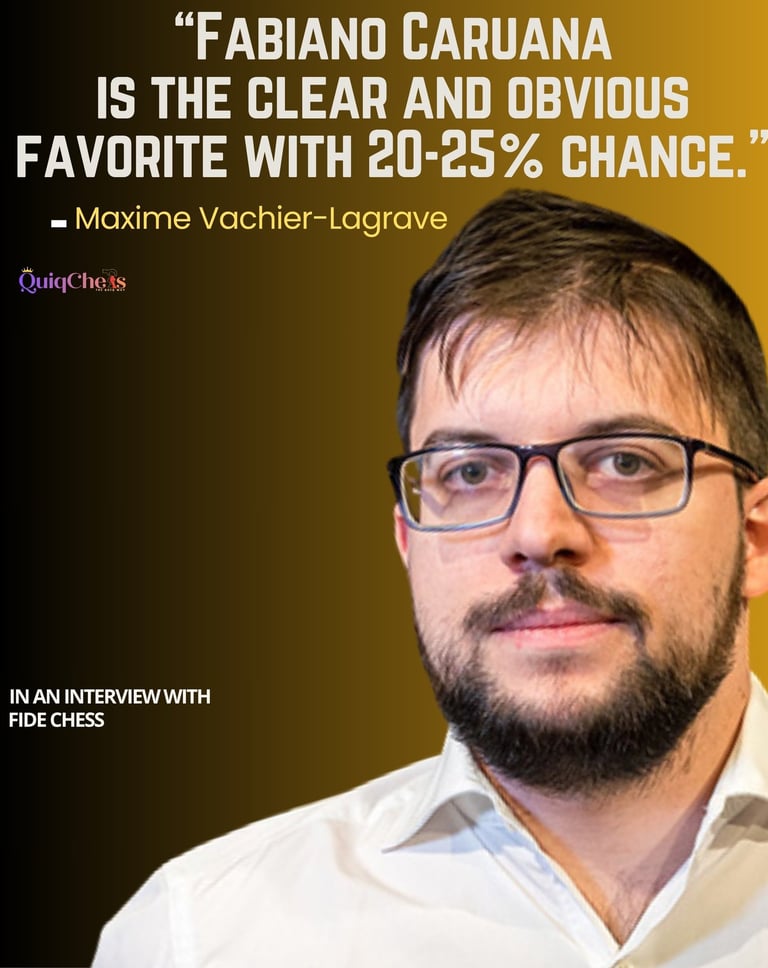
"I don't even know if I would put Magnus Carlsen at 40% chance to win the candidates' - Maxime Vachier-Lagrave
In an interview with FIDE, GM Maxime Vachier-Lagrave examines the unique intensity of the FIDE Candidates Tournament, noting that the "win-at-all-costs" format encourages aggressive preparation and higher risk-taking than other events.
CHESSNEWSSPORTS
QuiqChess
3/27/20263 min read
Maxime Vachier-Lagrave: The 2026 FIDE Candidates and Chess Strategy
In this interview with FIDE, GM Maxime Vachier-Lagrave examines the unique intensity of the FIDE Candidates Tournament, noting that the "win-at-all-costs" format encourages aggressive preparation and higher risk-taking than other events. He identifies Fabiano Caruana as the statistically likely favorite while acknowledging that the narrow margins of top-level play mean any participant could realistically over perform to take first place. The discussion highlights the psychological stamina and calculated nerves required to succeed, contrasting the Candidates with the World Cup, where qualifying spots can sometimes dampen the competitive drive in final rounds. Vachier-Lagrave also reflects on his own past experiences as a replacement player in the tournament and his enduring professional ambition to secure a world championship match. Ultimately, he suggests that while preparation is vital, a degree of luck and timing often determines who emerges victorious from such a gruelling elite competition. You can watch the full interview here.
Interviewer: What makes the FIDE Candidates Tournament so unique compared to other major chess events?
Maxime Vachier-Lagrave: Definitely one of the most special formats because it is quite long, a lot of things can happen. fourteen games over three weeks—but most importantly, only first place matters in the end. This causes players to take more risks and prepare much more deeply and aggressively that means things can go really exciting. Different in terms f excitement, I am not sure if I can qualify as a full classical event is the World Cup, which I also cherish, because there is tie-breaks and knockouts and that is why it is interesting, but also the first rounds are not that interesting and the middle part say from the third round till the quarter finals, the Candidates maintains high stakes throughout, whereas in other events, players might take fewer risks or find the final less meaningful if they have already qualified for the Candidates
Interviewer: Who do you consider the frontrunner for this edition?
Maxime Vachier-Lagrave: Fabiano Caruana is the clear and obvious favorite. This is his sixth Candidates; he consistently performs at the highest level and has a proven ability to win a lot of games, however, while some suggest he has a 40% chance, I would rank him as a 20 to 25% favorite n a tournament like this, you have to over-perform no matter how strong you are—even Magnus Carlsen at his best would likely not have a 40% chance of winning.
Interviewer: Are there any players who might surprise the field?
Maxime Vachier-Lagrave: It is interesting this year because players like Andrey Esipenko and Matthias Bluebaum, whom you might not have expected at the start of the year, proved they deserved to be here through their performances in the World Cup and Grand Swiss. They are well-prepared and can strike back if an opponent pushes too hard. If I had to pick outsiders to win, I would look at Anish Giri or Wei Yi. Their styles are well-suited for this event because they are solid, well-prepared, and know how to capitalise when mistakes happen.
Interviewer: You mentioned the importance of "over-performing." How much do luck and nerves play into the final result?
Maxime Vachier-Lagrave: There is definitely luck involved. It could be a good start, your preparation going exactly your way, or playing an opponent at the end of the event who has lost motivation because they have nothing left to play for. Good nerves are essential. You need a mix of stamina for the long tournament and the ability to find a way to calm your brain down while staying energetic for the games. You also need the ability to take calculated risks at the right moments.
Interviewer: Looking back at the history of the tournament, which moments or performances stand out to you?
Maxime Vachier-Lagrave: Ian Nepomniachtchi winning two Candidates in a row was convincing, in general, though I did manage to beat him in 2020. Gukesh also did very well in 2024. There have been crazy moments, like in 2013 when both Magnus and Vladimir Kramnik lost in the final round because they were both pushing to win at all costs.
Interviewer: You have your own history with this tournament. What do you remember most about your experience in the 2020 Candidates?
Maxime Vachier-Lagrave: It was quite an adventure because I only got in as a replacement. I found out while I was in a taxi coming back from vacation, just two weeks before the event. I had to rush to get a visa and make everything happen. I really enjoyed the first half of the experience, but the second half was tougher, particularly a loss to Fabiano that was very memorable for the spectators but costly for me.
Interviewer: Do you still have ambitions to compete for the World Championship?
Maxime Vachier-Lagrave: As long as I am an active player, I will try to qualify for the Candidates and play for the match because that is my nature. I know how tough it is to qualify, but I have reached three World Cup semi-finals before, so if things go my way, I definitely think I can do it again.
What are your thoughts on this?
Credits to FIDE for the interview.
