
How chess can rewire a generation lost to screens
How Chess Can Rewire a Generation Lost to Screens? The Addiction That Crept Into Every Pocket There was a time when parents whispered about television the way communities once spoke of moral failings. A child glued to the set on a weekday evening invited raised eyebrows. Two or three serials were ac
CHESSNEWSSPORTSEDUCATION
Swarup Bhattacharya
3/22/202610 min read
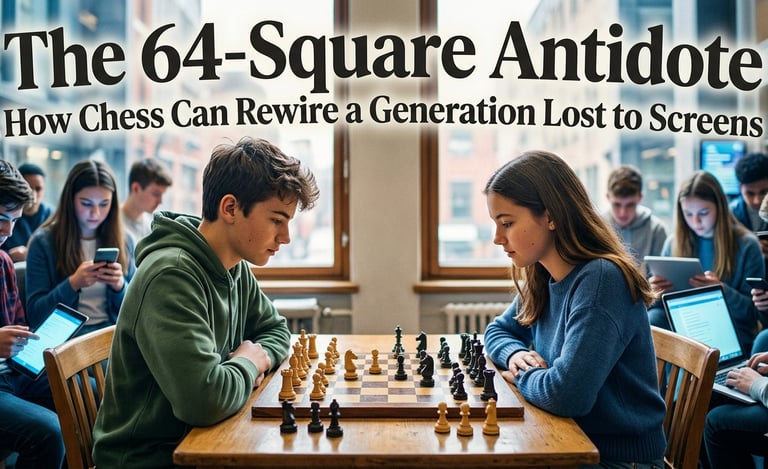
The Addiction That Crept Into Every Pocket
There was a time when parents whispered about television the way communities once spoke of moral failings. A child glued to the set on a weekday evening invited raised eyebrows. Two or three serials were acceptable. Anything beyond that edged toward indulgence, and too much of it was treated as something close to a character flaw.
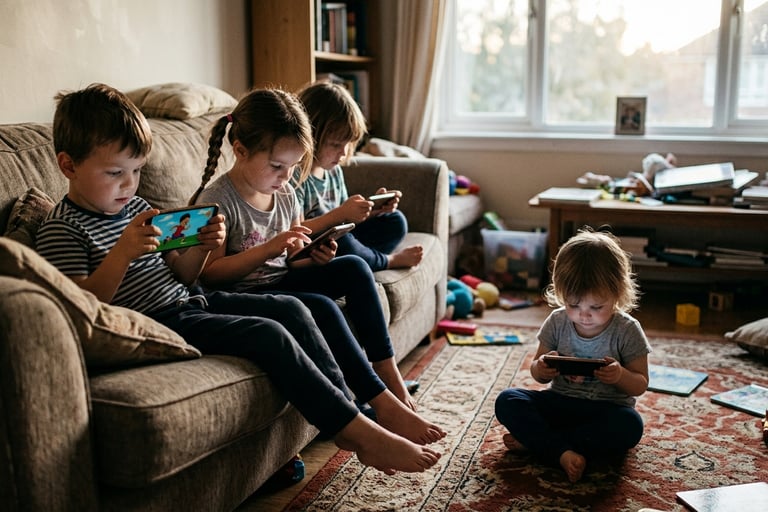
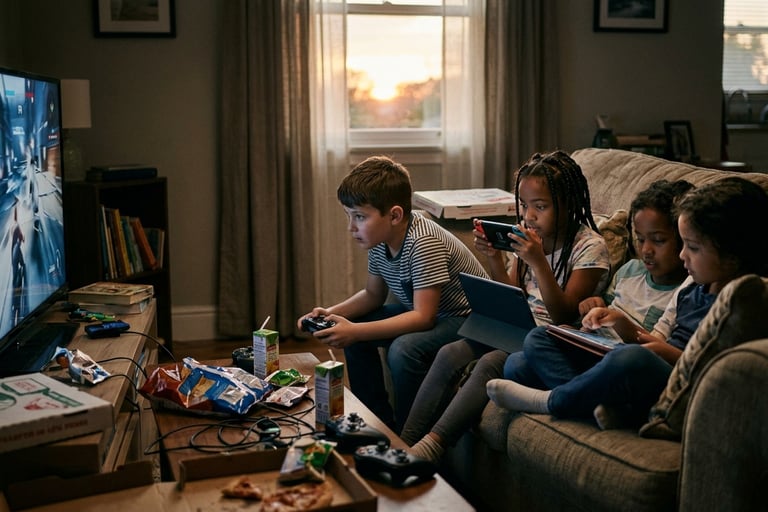
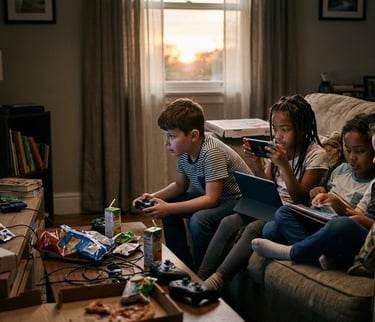
That world seems quaint now. The television stayed in the living room. Today's screen travels in a child's pocket, buzzes under the pillow at midnight, and greets them before they have even rubbed sleep from their eyes. The addiction that once came dressed in a cathode-ray tube has reinvented itself into something far more invasive — a pocket-sized ecosystem engineered by the most sophisticated behavioural scientists on earth. Social media platforms are not passive entertainment. Their algorithms are precision instruments, calibrated to hold attention the way a fishhook holds a catch. Every swipe that delivers a new image, every notification that arrives at a random interval — these are not accidents of design but calculated triggers of the brain's reward circuitry. The result is a near-continuous secretion of dopamine-adjacent neurochemicals, creating a biochemical loop that feels indistinguishable from the earliest stages of substance dependency.
Children are especially vulnerable because the prefrontal cortex — the brain's seat of judgement, impulse control, and long-term planning — does not fully mature until the midtwenties. Handing a developing brain a device engineered to exploit its reward system is, in neurological terms, something of a controlled experiment with deeply uncertain outcomes.
The consequences have not remained theoretical. Attention spans have contracted. The ability to sit with discomfort, boredom, or delayed gratification — qualities that underpin almost every meaningful achievement in a human life — have weakened measurably across the generation that grew up with touchscreens. We are not talking about a distraction. We are talking about a rewiring.
The World Health Organisation gave this phenomenon a formal name: Gaming Disorder and Problematic Internet Use. The clinical terminology signals that what was once dismissed as teenagers being teenagers now meets the diagnostic threshold of a recognised disorder. Reports of children harming themselves, or taking their own lives, after devices were confiscated are no longer isolated headlines. They are a pattern.
What Research Says About Chess and Addiction
Against this backdrop, a question worth asking seriously is whether chess — one of the oldest competitive mind games on earth — possesses qualities that directly counteract the cognitive damage inflicted by digital dependency.
The short answer, increasingly supported by research, is yes. But to understand why, it helps to examine what digital addiction actually does to the brain, and then see where chess applies pressure in precisely the opposite direction.
Digital addiction thrives on three specific cognitive weaknesses: impaired self-control, fractured attention, and an inability to tolerate the slow reward. Chess, as it happens, trains exactly these three capacities. This is not coincidence; it is the nature of the game. Every position on the board demands that a player suppress the first impulsive move that comes to mind and search deeper. Every session asks the player to sustain attention on a single problem for ten, twenty, or forty minutes at a stretch. Every game teaches — often painfully — that good results come only after patient, disciplined thought.
A 2021 study conducted at Walden University found that structured chess instruction led to measurable improvements in working memory and decision-making ability in children. Critically, the research pointed to a reduction in what psychologists call impulsive responding — the reflexive reach for immediate stimulation that lies at the heart of screen dependency. Children who played chess regularly began demonstrating a capacity to pause before acting, a skill that does not develop naturally in a scroll-and-tap environment.
More striking findings emerged from the FIDE Social Chess Research Conference held in February 2025, where Prof. Dr. Sabine Vollstädt-Klein of the Central Institute of Mental Health in Mannheim presented years of clinical work. Her research found that chessbased cognitive training strengthened the brain's reflective system — the deliberate, thoughtful mode of processing that addiction systematically suppresses.
What makes the Mannheim research particularly relevant is that it was not conducted on children learning chess for fun. It was conducted on adults with alcohol and tobacco use disorders. Chess-based cognitive remediation, tested alongside standard treatment, produced greater improvements in attention, executive function, and cognitive flexibility, and generated stronger activation in key prefrontal regions of the brain. In other words, chess was demonstrably changing the architecture of addicted brains — and not just changing behaviour, but changing the neural substrate underneath it.
If chess can accomplish this in adults who have spent years locked in substance dependency, the implications for children whose digital habits are still forming are considerable.
Organisations That Are Already Acting
The academic research does not exist in a vacuum. Around the world, organisations with very different starting points have arrived at similar conclusions about chess and young minds.
Chess in the Schools — New York City
Established in 1986, Chess in the Schools has worked in low-income New York City public schools for nearly four decades, reaching over half a million students. Its explicit goal is to use chess to develop the mental discipline and critical thinking that formal schooling often struggles to instil in children from under-resourced communities. What began as an educational experiment has produced decades of evidence that structured chess instruction changes how children approach problems, manage frustration, and persist through difficulty — the same capacities that excessive screen time degrades.
FIDE and the Global Chess in Education Movement
The International Chess Federation has moved decisively in recent years to position chess as an instrument of social development, not merely competitive sport. Its Chess for Mental Health conference, held in Paris in 2022, brought together the World Health Organisation, French government health ministries, and international psychiatric bodies to examine the therapeutic dimensions of chess. FIDE Vice President Anastasia Sorokina noted at that event that chess initiatives were being deployed across contexts ranging from refugee support to autism therapy — circumstances where the game's demand for focused, rule-bound thinking provides an anchor for minds under profound stress.
The FIDE Social Chess Research Conference in February 2025 extended this work further, with researchers from multiple countries presenting findings on chess as a tool for cognitive remediation, addiction recovery, and educational development. FIDE has since declared 2026 the Year of Chess in Education, launching a global programme to integrate chess into school curricula across multiple continents. In Pakistan alone, preparations are underway to introduce chess into 150 schools across Punjab as a pilot initiative, training one teacher in each school.
Zindagi Trust — Pakistan
Pakistani activist and musician Shehzad Roy made his message direct: if you want to lower your children's screen time, teach them chess. His non-profit organisation, the Zindagi Trust, introduced chess into government schools in Karachi in 2011 and has spent over a decade refining a curriculum that combines competitive play with cognitive training. The curriculum, recently made freely public, has produced national chess champions among girls from some of Karachi's most economically disadvantaged communities. Roy's observation — that children who normally struggle to sit still for ten minutes will voluntarily spend hours alone, thinking over a chessboard — points to something the research literature confirms: chess activates a different quality of engagement than passive screen consumption. It is not merely an alternative activity. It is a neurologically distinct one.
The Gift of Chess
The Gift of Chess, co-founded by Tyron Davis III, operates at the intersection of digital inclusion and cognitive development, distributing chess sets and instruction to underserved communities globally while also integrating digital chess tools as a bridge. The organisation's presence at FIDE's 2025 Smart Moves Summit, which brought together educators, policymakers, and social entrepreneurs from across the world, reflects the growing conviction that chess is not simply a game for academically gifted children — it is a scalable social intervention.
Chess and ADHD: A Window into the Scrolling Problem
There is a clinical parallel that deserves attention. Attention Deficit Hyperactivity Disorder is characterised by short attention span, impulsivity, emotional dysregulation, and restlessness — symptoms that overlap substantially with what clinicians are now observing in children with severe digital dependency. This is not a coincidence. Both conditions involve dysregulation of the same dopaminergic pathways in the prefrontal cortex.
Chess has been studied as a therapeutic intervention for ADHD across multiple clinical trials. A 2023 randomised controlled trial published in JMIR Serious Games found that therapeutic chess improved inattentive symptoms in adolescents with ADHD, with the most significant gains appearing in emotional regulation, emotional intelligence, and interpersonal functioning — exactly the capacities that both ADHD and excessive screen use tend to erode.
A 2025 pilot study from the Central Institute of Mental Health in Mannheim found that adolescents with psychiatric disorders who participated in weekly chess sessions showed significantly improved working memory compared to a control group, along with meaningful gains in psychological well-being. This is notable because working memory — the capacity to hold and manipulate information over short periods — is one of the first cognitive functions to suffer under conditions of chronic digital overstimulation.
The chess-ADHD research matters for the digital dependency conversation because it suggests that chess is not merely an activity that competes with screen time for attention. It appears to address underlying neurological vulnerabilities that make children susceptible to addictive digital behaviour in the first place. Treating the soil, not just the weed.
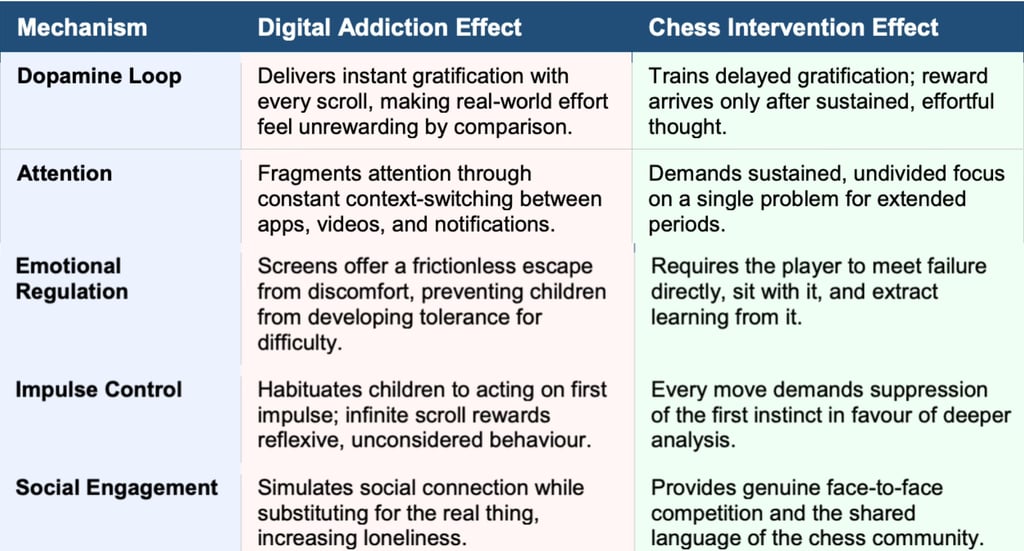
The Mechanism: Why Chess Works Against Digital Addiction
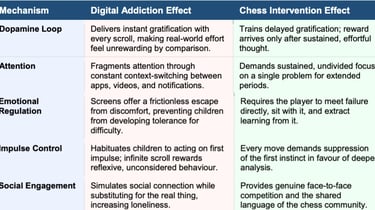
The following table maps the specific psychological mechanisms through which digital addiction takes hold, and how chess intervenes at each point.
A Practical Guide for Parents: Using Chess to Counter Mobile Addiction
Research and institutional programmes are useful to know about, but what a parent facing a phone-dependent child needs is something more immediate: a workable approach for the home. The following guide is not a rigid protocol. It is a set of principles drawn from what the evidence suggests actually works.
1. Begin Before the Problem Deepens
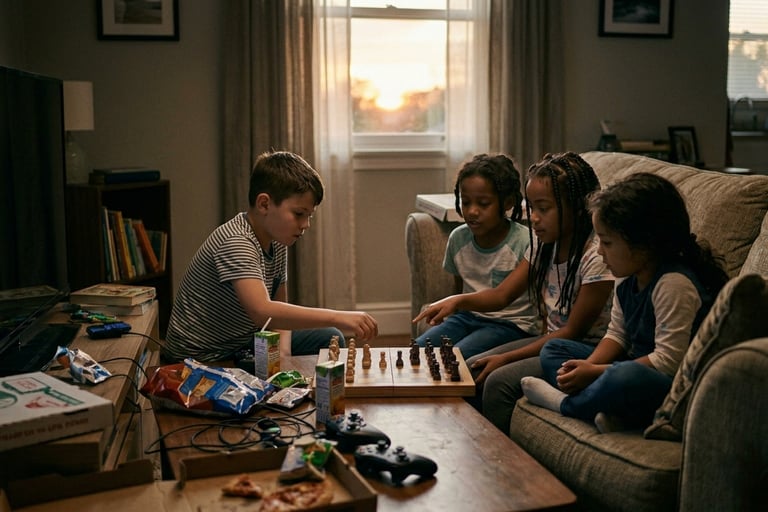
Chess is far easier to introduce as a natural part of family life than as a corrective measure handed to a child who already resents restriction. Children between the ages of five and nine are at an ideal stage — old enough to grasp the rules, young enough that the game feels like play rather than therapy. Introduce it casually, with no pressure to be good at it. The goal in the beginning is simply familiarity.
2. Play With Them, Not At Them
The single most powerful thing a parent can do is sit across the board. Not to teach, not to correct, but to play. A child who experiences chess as something an adult finds worth their time will attach a different value to it than one who is handed a set and pointed toward YouTube tutorials. Your presence at the board communicates something a screen cannot: that this activity is worth human attention.
3. Replace, Rather Than Restrict
The instinct to take the phone away is understandable but rarely productive on its own. Children deprived of one dopamine source will find another, often with more ingenuity than parents anticipate. The more effective approach is to create a competing pull — a fixed, appealing chess routine that the child begins to look forward to. Start with fifteen minutes before or after dinner. Let it be irregular at first. The aim is to build an association between the chess set and positive feeling, not compliance.
4. Use Tournaments as Motivation
Something changes in a child the first time they compete. Not because winning matters most, but because preparation for competition gives practice a purpose. Chess tournaments for children exist at school, club, district, and national level in most countries, and entry-level competitions are genuinely accessible regardless of ability. When a child has a real tournament on the calendar, they will study positions voluntarily — the same voluntary absorption into a task that screens currently monopolise.
5. Leverage Digital Chess Wisely
It would be both ironic and impractical to insist that chess can only be played on a physical board. Platforms such as Chess.com and Lichess offer structured learning environments, puzzles, and games against opponents of matched ability. Used intentionally — as a gateway to the physical game, with time limits and purpose — digital chess can serve as a bridge rather than a substitution. The key distinction is between active engagement (solving a puzzle, playing a rated game) and passive consumption. Chess on a screen is not the same as scrolling on a screen.
6. Normalise Losing
One of the deepest habits that screen dependency forms is an aversion to failure. Games with infinite lives, social feeds that can be curated, content that never pushes back — these create a child who has had very little practice sitting with the discomfort of having genuinely lost. Chess delivers honest defeat regularly, and the appropriate parental response is not sympathy but curiosity. What went wrong? What would you do differently? This conversation, repeated across hundreds of games, builds the emotional infrastructure that screens quietly dismantle.
7. Be Patient With the Timeline
Chess does not produce results in a week. The cognitive and behavioural changes that researchers document — improved working memory, stronger impulse control, reduced impulsivity — accumulate over months and years of regular play. A parent who introduces chess hoping to solve a screen problem in a fortnight will likely abandon it too soon. The correct frame is not remediation but cultivation: you are growing something in your child that will serve them for the rest of their life, and it grows at the pace of genuine things.
Closing Thought
The conversation about children and screens too often takes the shape of prohibition: restrict this, ban that, add parental controls here. Prohibition without substitution has a poor record. What the evidence for chess suggests is that the most effective counter to a passive, algorithmically managed form of engagement is not more management, but a genuinely competing form of active, demanding, human engagement.
Chess is not a magic remedy. It does not immunise a child against the attraction of social media, and it does not replace the need for parents to model healthy digital habits themselves. But it does something rare and valuable: it makes the slow reward feel worth waiting for. In a world engineered to make that lesson as difficult as possible to learn, the sixty-four squares of a chessboard may be one of the most subversive educational tools available.
Sources and references available on request. Research cited includes studies from Walden University (2021), the FIDE Social Chess Research Conference (February 2025), the Central Institute of Mental Health Mannheim (Vollstädt-Klein et al., 2022–2025), JMIR Serious Games (2023), BMC Psychology (2025), and Frontiers in Psychology (2025). All images generated by google gemini ai

About the author - Swarup Bhattacharya
I’m a fast-aging dreamer, finding my peace and passion on the road. Specifically, I love to go around by meandering roads in my wife’s old car—a simple joy constantly challenged by the rising cost of petrol. This necessity keeps me with a close watch on geopolitics and macroeconomics, tying my personal challenge to the world’s stage.
Beyond the road, I am a devoted defense enthusiast, and I am genuinely worried about India’s depleting air assets. This concern is a heavy backdrop to my daily thoughts, a reflection of my commitment to national security and strength.
Now, in the second half of my life, something has shifted. I’ve suddenly decided to launch a digital second act, embracing the advent of social media and the wide-ranging digital proliferation to express myself in different forms.


My post content
