
For young players like Vaishali, the past isn't as important as their current form - Tan Zhongyi
In this interview with, the 16th Women’s World Chess Champion Tan Zhongyi reflects on her extensive experience competing at the highest levels of the game.
CHESSNEWSSPORTS
QuiqChess
3/28/20264 min read
For young players like Vaishali, the past isn't as important as their current form - Tan Zhongyi
In this interview with Theophilus Wait, the director of operations - Lichess, the 16th Women’s World Chess Champion Tan Zhongyi reflects on her extensive experience competing at the highest levels of the game. She discusses the evolution of her mindset across four different Candidates tournaments, noting that while veteran experience prevents major errors, it does not guarantee a victory. The conversation explores the cultural influences of her home city, Chongqing, on her resilient playing style and compares the unique pressures of match play versus tournament formats. Tan also shares her perspective on the rising talent in Chinese chess, the psychological challenge of recovering from losses, and her preference for using Lichess for tactical training. Throughout the exchange, she emphasises the importance of emotional composure and the necessity for professional players to accept failure as a standard part of their career. You can watch the full interview here - Tan Zhongyi: Us ordinary players accept failure first | Candidates 2026
Theophilus Wait: We are very lucky to be joined by Tan Zhongyi, the 16th Women’s World Champion and a multi-time national champion. You are very familiar with this tournament and its format. Do you think being a veteran of the Candidates gives you an edge?
Tan Zhongyi: I don’t think it’s necessarily an advantage, but there is less for me to adapt to. I have the experience to know not to push too hard or try too much to impress at the start, which younger players sometimes do. However, experience only guarantees you won’t play too poorly; it doesn't guarantee a title. We’ve seen players like Gukesh or Vaishali succeed or qualify in their very first attempt.
Theophilus Wait: This is your fourth time playing this level of tournament. Do you remember how it felt the first time, perhaps in terms of anxiety?
Tan Zhongyi: Each time the mentality is different. Interestingly, I didn’t actually want to participate in 2019. I told my coaches, but my teacher, Ye Jiangchuan, told me very seriously that I wasn't just representing myself, but China. The 2021 season was also very difficult due to format changes and external reasons; I lost to my best friend, Lei Tingjie, in a match I treated with the intensity of a World Championship. By the third time in Toronto, I wasn't as well-prepared but was much more relaxed, which helped me start strong.
Theophilus Wait: Speaking of Toronto, you won your first round there. How do you view the early rounds of a tournament like this?
Tan Zhongyi: It is hard to say. The first two games often depend on mindset, jetlag, or just getting into the rhythm. Upsets are more common early on. As the tournament progresses, everyone tends to stabilize. Since I started with consecutive games as Black, my goal was simply to play conservatively and hold those draws.
Theophilus Wait: You've played Vaishali many times since 2012. How do you assess her growth as she becomes one of the favourites?
Tan Zhongyi: For young players, the past isn't as important as their current form. Her rating has climbed so quickly that I can’t accurately estimate her strength until we actually sit across the board. Once we play, I will be able to judge if we are still at a similar level or if I can still find weaknesses in her game.
Theophilus Wait: You once mentioned that a player’s style can be linked to their home city. You are from Chongqing, while Ding Liren is from Wenzhou. How does that manifest?
Tan Zhongyi: Players from Ding Liren’s area tend to be very stable, resilient, and perhaps less expressive, though Ding’s style is actually very sharp in the middle game. My home city, Chongqing, is a place where modern meets tradition, but historically it was a very difficult, poor place to live. This forged a spirit of resilience in the people—they are hard to defeat. I think that comes through in my playing style as someone who is resourceful and enjoys attacking.
Theophilus Wait: During your World Championship match, you had a win followed by successive losses. How do you handle those emotional ups and downs?
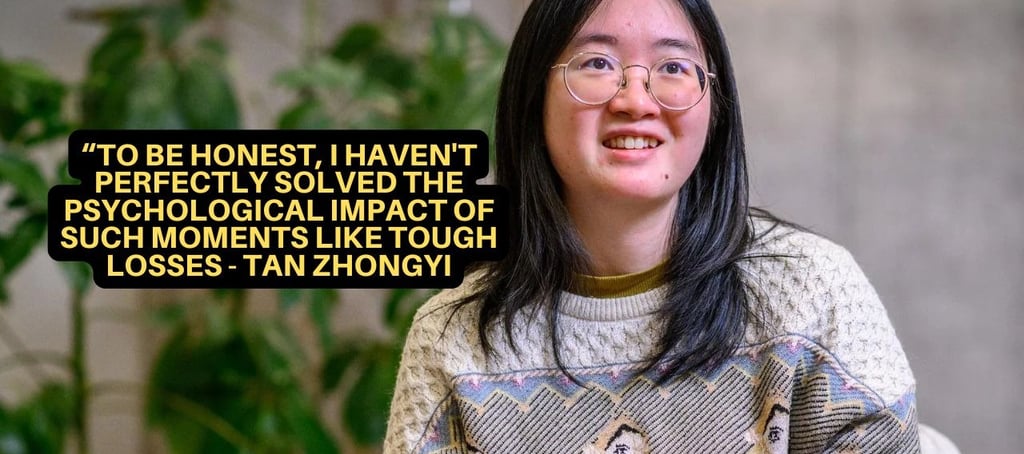
Tan Zhongyi: To be honest, I haven't perfectly solved the psychological impact of such moments. At my age, I might not be able to fully fix it, so I try to mask it. If the pressure isn't high enough, the problem doesn't show, but once it's exposed, it’s hard to adjust quickly. While people say I have good psychological endurance, it’s mostly that I can accept failure, even though it still affects me during the process.
Theophilus Wait: You seem so calm over the board. Have you ever had a "Magnus Carlsen" moment where you wanted to hit the table?
Tan Zhongyi: Almost never. If I am angry, I am angry at myself for not doing better. For example, when I blundered a win against Vaishali in the World Rapid, I wasn't angry; I was just stunned and embarrassed. I just wanted to leave the room quickly.
Theophilus Wait: Having won both the Candidates and the World Championship, which do you think is more challenging?
Tan Zhongyi: From my perspective, the World Championship match is harder. I have lost three major matches now—including one to Lei—so I haven't "won" at that level yet. In contrast, I have won the Candidates, which feels better. But as a professional, you have to accept failure. In any tournament, there is only one winner and everyone else is a "loser." You must accept this so you don't hurt yourself.
Theophilus Wait: Is there a "Chinese school of chess" that explains the incredible depth of talent in China?
Tan Zhongyi: That is hard to answer because China is so vast. Beyond the national team, each region—like Zhejiang or Jiangsu—has its own characteristics. People think there is an "Eastern mystery" to it, but it’s really just about the individual teams players build for themselves.
Theophilus Wait: Finally, I know you use Lichess puzzles to stay warm. Do you still use them? And how is your English study going?
Tan Zhongyi: Yes, I use Lichess a lot for tactics and teaching; I even recommend it to my students. As for English, I am studying, but my friends’ Chinese is getting better faster than my English! I can understand a lot, but speaking is difficult because if I get one small thing wrong, the meaning changes completely. I need a professional to help me, but I'm happy to talk if you speak slowly!
