
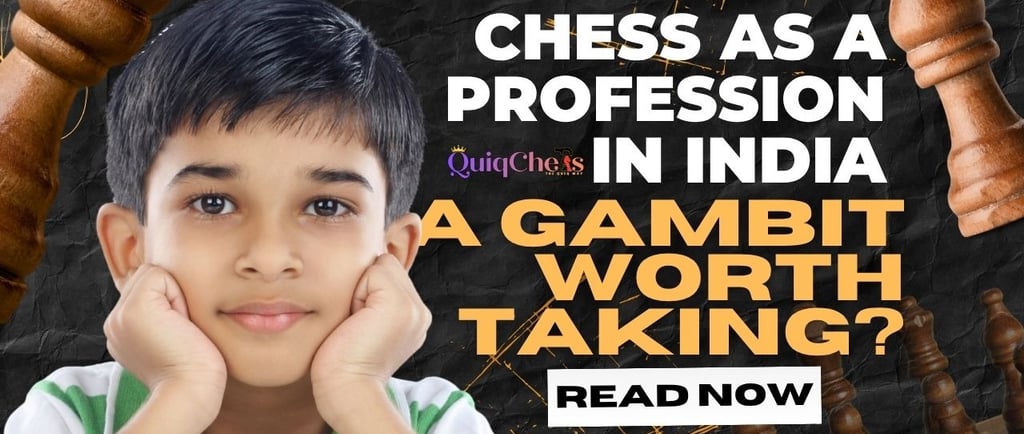
Chess as a Profession in India: A Gambit Worth Taking?
Can someone in India take chess as a profession? Can they become wealthy doing it? Again, yes. But here's where it gets interesting—and complicated. Ask whether someone can become an actor and earn like Shah Rukh Khan. The answer is technically yes, but the odds? Not even remotely close. Chess works the same way. The dream exists. The path is real. But the journey demands more than talent alone.
CHESSNEWSSPORTSEDUCATIONFINANCE
Ace Bee Dark Brown
11/17/20255 min read
The Anand Effect: How One Man Changed Everything
India's relationship with chess runs deep. The game traces its ancestry to Indian soil, evolving from the ancient chaturanga. But modern Indian chess—the kind that fills stadiums and createscareers—began with one man: Viswanathan Anand.
When Anand became India's first Grandmaster in 1988, and later a five-time World Champion, he transformed chess from an intellectual pastime into a coveted arena of heroism. His six Chess Oscars and countless achievements weren't just personal victories. They were sparks that ignited a flame.
That flame has since grown into something remarkable. As of October 2025, India boasts 90 Grandmasters—a staggering leap from the solitary figure Anand once represented. The ecosystem has matured. Chess academies proliferate in cities. Young prodigies like D. Gukesh became the youngest-ever undisputed World Chess Champion at 18 in December 2024. The virtuous cycle is spinning faster: more masters create more opportunities, which create more masters.
Yet reality demands a closer look. Only the top 1%—the Grandmasters, the International Masters—earn exceptional money through tournament prizes, sponsorships, coaching gigs, and brand ambassadorships. Everyone else? They're playing a different game entirely.
The Money Question: What Can You Actually Earn?
Let's cut through the romance and talk numbers.
The Elite Tier (Top 1%): Tournament professionals at the highest level can earn over ₹10 lakh annually from prize money alone, with top earners like Praggnanandhaa making over ₹2 crore through diversified income including brand endorsements. These are the rarified few.
Mid-Level Professionals: Coaches with FIDE ratings below 1600 can earn ₹50,000 to ₹80,000 per month, while stronger players often exceed ₹1,00,000 monthly. But here's the catch—this income flows primarily from coaching and content creation, not tournament victories.
Semi-Pros and Part-Timers: For most, chess remains a side hustle rather than a main act. They teach, they create content, they organize events. The board itself pays less consistently than the ecosystem around it.
Walk through Kolkata or Chennai and you'll hear chess clocks clicking in halls, malls, even along boulevards. The sound is everywhere. But pursuing chess professionally isn't "easy" —it's merely "viable. " Government support through sports quota recruitment in organizations like Indian Railways, ONGC, and LIC provides starting salaries around ₹25,000 per month plus training allowances, offering a safety net that previous generations lacked.
Five Paths Through the Chess Landscape
1. Tournament Players
This is the glamorous path, where prize money and sponsorships concentrate at the peak. The cream gets everything. The rest get experience and travel stories. International tournaments can cost ₹3 to 5 lakh in travel and lodging expenses, while national tournaments run ₹50,000 to ₹1,00,000. You're spending money to chase money, and only a fraction wins big.
2. Instructors and Coaches
The chess boom created this goldmine. Academies and coaching centers have multiplied, opening stable opportunities for instructors at every level. Coaching rates range from ₹500 to ₹1,500 per hour for basics, jumping to ₹2,500 to ₹3,000 per hour with renowned Grandmasters, and even reaching $150 to $200 per session (roughly ₹13,000 to ₹15,000) for elite international coaching. Teaching chess isn't settling—it's surviving smartly.
3. Commentators
Just like any sport, chess needs voices. Commentators blend public speaking skills with deep game understanding. They're part of the content creation wave, adding narrative to moves, making complexity digestible. It's specialized work, but the space is growing.
4. Content Creators
Digital media exploded and chess rode the wave. YouTube channels, Twitch streams, blog posts, Instagram reels—the chess niche has enormous following and endless appetite for content. Platforms like ChessBase India demonstrate how niche content can attract substantial sponsorships through tutorials and tournament coverage. Create well, build community, monetize consistently.
5. Sports Quota Government Jobs
This is stability wrapped in a dream. The best of the lot secure government positions that provide financial security while allowing continued competitive play. It's not common, but it's transformational when it happens.
Decoding FIDE: Your Professional Report Card
Every serious chess professional needs to understand the FIDE rating system—it's essentially your skill certificate in this profession.
FIDE (Fédération Internationale des Échecs—the World Chess Federation) assigns each player a rating representing their relative strength. The system follows physicist Arpad Elo's model.Your rating shifts more dramatically when you're lower-rated; as you strengthen, your "K-factor" shrinks and changes become subtler.
Here's the rough hierarchy:
1400-1800: Decent club strength
2000+: Serious competitive level
2300-2600+: Professional/titled players territory
Titles themselves depend on these ratings, making your number both identity and opportunity in one. It's where ambition meets measurement, where potential becomes quantifiable.
A Roadmap: From Novice to Notable
Let's map the journey in three phases.
Phase One: The Initiation (Years 1-2)
Move One: Master the basics rigorously—tactics, endgames, openings. Local FIDE-rated tournaments aren't just competition; they're education. Participate relentlessly.
Move Two: Leverage digital platforms. Post game analyses. Build a small community. Visibility matters from day one.
Move Three: Register for an AICF and FIDE-rated tournaments and perform your best. Once you play and score substantial points and the arbiter submits player IDs, you'll receive your FIDE ID within a week. Aim to push your rating above 1400.
Phase Two: Bulking Up (Years 3-4)
Move One: Find a coach. Focus intensifies now. Participate in national and international opens if possible.
Move Two: Start part-time coaching yourself. It helps manage finances while you're still building your competitive standing.
Move Three: Establish digital presence—YouTube, streaming platforms, online classes. This isn't vanity; it's professional infrastructure.
Move Four: Become visible in state and national arenas. Network aggressively. Visibility has become the new currency.
Phase Three: Decision Time (Year 5+)
Move One: Choose your primary path. Pure tournament play? Or a broader chess business encompassing coaching, content, events?
Move Two: If business calls to you, build your brand. Consider starting an academy. Scale through digital collaboration.
Move Three: If competition is your singular focus, pursue International Master and Grandmaster norms. Higher ratings unlock sponsorships and serious prize money.
Move Four: The middle path—competing while establishing stable income streams throughcoaching and other means. Ambition blended evenly with stability.
The Brutal Truth: Courage Meets Caution
The numbers don't favor newcomers. Tournaments cost money—training, traveling, entry fees—all stacked against the slim chance of a big win that only a fraction achieves.
A Reddit user captured the reality perfectly: "Earning ₹30,000/month coaching kids is more feasible than grinding tournaments" Reaching GM level requires 10+ years at the least of dedicated training, and even then, inconsistent tournament payouts make financial planning difficult.
Chess is no longer just an indoor game for intellectual stimulus. Through ages and accelerating modern times, it evolved into craft, skill, job, business, and personal brand. It's all of these simultaneously, and which one dominates depends on your choices.
Your Move
So think carefully before making your gambit. Consider which pieces you're willing to sacrifice and which you'll protect. Will you push toward tournament glory? Build a coaching empire? Create content that resonates? Or blend all three?
The board is set. The clock is ticking. But unlike in rapid chess, you have time to think this one through. Just remember—in professional chess, the opening move is only the beginning. It'show you navigate the middle game and finish strong that determines whether you're playing for survival or for victory.
What will your first move be?
