
Can your child become a chess grandmaster in India? The Checkmate Economy
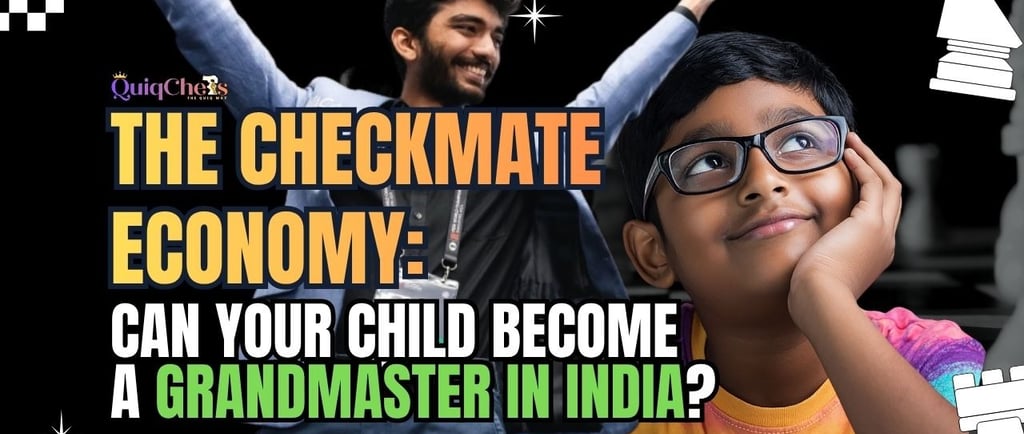
In 2024, an 18-year-old from Chennai named Gukesh Dommaraju became the youngest undisputed World Chess Champion in history. His victory wasn't just a personal milestone—it was confirmation of something larger. India is now the beating heart of world chess. The country that once celebrated a single champion now produces Grandmasters the way it produces engineers: systematically, relentlessly, brilliantly. But can you?
CHESSNEWSSPORTSEDUCATION
Ace Bee Darkbrown
11/20/20259 min read
The Checkmate Economy: How to be a chess Grandmaster!!!
The wooden pieces sit quietly on the board. Then someone moves. Then another. And somewhere between those moves, a life gets decided.
In 2024, an 18-year-old from Chennai named Gukesh Dommaraju became the youngest undisputed World Chess Champion in history. His victory wasn't just a personal milestone—it was confirmation of something larger. India is now the beating heart of world chess. The country that once celebrated a single champion now produces Grandmasters the way it produces engineers: systematically, relentlessly, brilliantly.
But here's the uncomfortable truth that nobody puts on motivational posters: becoming a Grandmaster is not a fairy tale. It's not about being naturally gifted. It's part talent, part suffocating work schedule, part strategic financial planning, and part bureaucratic navigation.The romantics talk about the beauty of the game. The professionals talk about rent.
This is about the latter.
Understanding the Mountain: What Does It Actually Take?
Before you quit your job or pull your child out of school, understand what FIDE—the World Chess Federation—actually demands. FIDE uses the Elo rating system, which calculates the relative skill levels of players, a numerical representation of chess strength invented by Hungarian-American physics professor Arpad Elo.
The FIDE Rating System: Your Professional Report Card
Think of your FIDE rating as your professional reputation condensed into a single number. Every FIDE-rated tournament game you play adjusts this number based on how you perform against your opponents. The stronger or higher-rated the opponents, the more your chance to increase your ELO.
The K-factor is the development coefficient that determines the maximum points you can gain or lose in a single game. When you're new to the rating list, your K-factor is 40—meaning your rating can swing dramatically with each game. This drops to 20 once you're below 2400, and to just 10 once you hit 2400 or above. The system is designed to reflect your actual strength quickly when you're developing, then stabilize as you reach elite levels.
Here's how it works in practice: if you're rated 1500 and face someone rated 1600, the higher-rated player has a 64% winning chance while you have a 36% winning chance. Win that game, and you gain more points than expected. Lose, and you lose fewer points. The system rewards upsets and punishes underperformance.
FIDE publishes new ratings monthly, usually at the end of each month, so serious and professional players watch the calendar carefully, timing tournament participation to maximize their rating improvements.
The Two Numbers That Define Your Career
The Rating: 2500.
That's the threshold. Cross it once in your life, and you're eligible for the Grandmaster title. Fail to reach it, and everything else—every tournament, every sleepless night analyzing positions, every rupee spent—becomes a footnote. There are certain cases where a player winning a FIDE World championship can also be granted a grandmaster title. We will cover the topic in a different article. You can also refer to the FIDE handbook.
The Norms: Three of them.
To get an initial FIDE rating, a player must face 5 rated players and score 0.5 points against any of the rated opponents. But norms are different beasts entirely. They're high-performance certificates from specific tournaments. You typically need a performance rating of 2600+ in that tournament. You must play at least 9 rounds. You must face a specific number of Grandmasters—usually three. And here's the bureaucratic trap: you must play opponents from different federations, which essentially means you have to face players representing different federations or countries.
This last requirement is where many Indian players stumble. India now has so many strong players that you can deliver a GM-level performance in a domestic tournament but fail to secure a norm because you didn't face enough international opponents. The system wasn't designed for a chess superpower. You must travel. You must spend money. You must plan strategically.
The Ladder: Where Are You, Really?
Self-delusion is expensive in chess. Be honest.
Under 1600: The Foundation
This is where the foundation of your chess understanding is built and this foundation will be the reason where you reach in your life as a chess player. Most players in the world can't up from here and there may be multiple reasons contributing to the cause. You should stop studying complex openings and focus more on openings which your comfortable playing even when you are out-prepared in the first few moves. Your problem isn't that you don't know the Najdorf Sicilian's latest theoretical nuances. Your problem is that you're dropping lose pieces. Focus more of your time on tactics and basic endgames—King and Pawn, Rook and Pawn. If you can't stop making elementary mistakes, strategy is meaningless. A good practice can be to be at least solve fifty puzzles each day. The more the better.
1600-2000: The Club Player
This is where systematic study begins. Build a solid opening repertoire, but don't just memorize moves—understand the plans behind them. Start studying middlegame structures: the Isolated Queen's Pawn positions, the Hedgehog formation, pawn chains. Pattern recognition starts here.It is time you understand that you need some serious training and should find a decent coach or practice partners. The best way to get better is to mix your training with practice games. No training would be giving you more knowledge that sitting down and grinding games over the board. The stronger the opponents the better.
2000-2400: The Master Grind
This is the hardest plateau. The difference between 2000 and 2400 isn't just skill—it's endurance. You need deep endgame study. You need engine preparation with Stockfish or Leela. You need to be in top shape not only mentally but also physically as classical games can last six hours or more, and exhaustion can cause mistakes and blunders. Many players spend years here. Some never escape.
2400+: The Norm Hunter
You're strong enough. The game has changed. Now it's about psychology, funding, and tournament selection. You're not playing chess anymore—you're playing the professional chess circuit.
The Daily Regimen: Years, Not Months
If you treat this as a hobby, you will remain a hobbyist.And that is fine only if you just enjoy playing chess. But incase if you want to move beyond your hobby and want to become a better player. Here is a plan. A future Grandmaster trains like this:
Tactics (90 minutes): High-repetition pattern recognition. Use the Woodpecker Method—solvethe same set of puzzles repeatedly until your responses become instant and instinctive.
Calculation (60 minutes): One deep puzzle. Take 20 minutes to calculate all variations without moving pieces. This builds the mental stamina required for tournament play.
Endgames (60 minutes): Study Dvoretsky's Endgame Manual. It's the bible.Classics (60 minutes): Don't watch YouTube recap videos. Set up a physical board. Replay games by Capablanca, Fischer, or Kasparov. Guess their moves. Understand their decisions.
Play and Analyze: Play classical games. After the game, analyze without an engine first.Exhaust your own brain. Only then check the computer to identify your blindspots.
That's four hours minimum. Daily. For years.
The Indian Advantage: Where You Train Matters
India's chess ecosystem is unmatched. But within India, three cities dominate. Your choice of location accelerates or delays everything.
Chennai: The Engine Room
Gukesh Dommaraju was born in Chennai and learned to play chess at the age of seven. This wasn't coincidence. Chennai is the heartbeat of Indian chess. The legacy of Viswanathan Anand created a culture where chess is treated with the same seriousness as engineering or medicine. The density of Grandmasters per square kilometer here is among the highest in the world.
The Style:
Players here are known for deep theoretical preparation. If you train in Chennai, expect to work hard on your opening lines. The Madras approach is methodical, disciplined, and unforgiving.
The Infrastructure:
Look for Chess Gurukul, run by GM R.B. Ramesh. Ramesh coaches Praggnanandhaa, and felt that the 19-year-old had been more 'adventurous' this year. The academy has produced multiple GMs including Praggnanandhaa. The Madras School of Chess offers another pipeline.
The Action:
The Tamil Nadu State Chess Association is hyperactive. There's a tournament almost every weekend. Attend the monthly rapid events at local clubs. You'll often find IMs and GMs playing casually. It's the best free sparring available.
Hyderabad: The Rising Tech and chess Hub
Hyderabad has rapidly modernized its chess infrastructure. It combines traditional rigor with modern, tech-aided coaching methods. Less saturated than Chennai but highly professional.
The Infrastructure:
Telangana is not only growing as one of the fastest growing states in the country in terms of real-estate and industries but also in chess. The capital city of Hyderabad, is home to six grandmasters and a wave of rising talents which is fuelled by the amazing chess ecosystem. You can find some of the best chess academies and also every weekend you will find a tournament to play and practice for all age groups and levels.
The Logistics:
Hyderabad is geographically central. It's an ideal base for traveling to tournaments in Bangalore, Mumbai, and Chennai without burning through your budget.
The Approach:
Many strong coaches from Andhra and Telangana offer hybrid training models. Use the local scene for over-the-board practice but don't limit yourself to in-person coaching. There are also institutions which have hostel facilities for players to train and stay.
Kolkata: The Soul of Chess
Kolkata treats chess as art. Home to the historic Alekhine Chess Club, the city has a cerebral, romantic approach to the game. Recently, it's become more commercial with the Tata Steel Chess India event bringing world-class players to the city. The city is also home to eleven grandmasters including India's second grandmaster, the legend Dibyendu Barua.
The Culture:
Join the Alekhine Chess Club at Gorky Sadan. The atmosphere is historic, almost literary. Chess here feels like it belongs in the same conversation as poetry and philosophy.
The Coaching:
The Dibyendu Barua Chess Academy, run by GM Dibyendu Barua, is the premier institution in the East.
The Style:
Players here are often incredibly creative and tactical. It's an excellent place to sharpen intuitive play. The West Bengal state selection tournaments are notoriously difficult—if you can compete here, you can compete anywhere.
The India Story: From Anand to Everywhere
In the September 2023 rating list, Gukesh became the top-rated Indian player, ending Viswanathan Anand's 37-year record. Read that again. Thirty-seven years. An entire generation where Indian chess meant one name.
Now? India has three players in the open top-10, underlining India's growing supremacy in the sport. Gukesh is the World Champion. Arjun Erigaisi is currently India no. 1 and the fifth highest-rated player in the world as of November, 2025. Arjun also crossed 2800. After Viswanathan Anand, he became the second Indian to surpass the 2800 Elo rating points.
India won their first-ever team gold medal at the Chess Olympiad in 2024, with Gukesh winning the individual gold medal. India also won the Chess Olympiad for the first time in Budapest, Hungary, ending decades of near-misses.
This isn't a lucky generation. It's infrastructure. It's coaching. It's a culture shift.
The Money Question: What Does It Actually Cost?
Chess is cheap to learn. A board costs nothing. Theory is free online. But chess is expensive to master.
Coaching: A good GM coach charges ₹2,000 to ₹10,000 per hour. If you need 10 hours a month, that's ₹20,000 to ₹1,00,000 monthly. Annually, you're looking at significant investment.
Travel: To secure norms, you'll need to travel. Europe—particularly Spain and Eastern Europe—offers more tournaments with diverse opponents. A single European tournament trip can cost ₹1,50,000 to ₹3,00,000 when you factor in flights, accommodation, registration fees, and living expenses.
Tournaments: Domestic FIDE-rated tournaments charge entry fees. International opens charge more. Budget ₹50,000 to ₹1,00,000 annually just for tournament registrations.
Equipment and Software: Premium chess software, opening databases, online memberships—these add up. Budget ₹20,000 annually. Plus you need to have a decent laptop to carry around and work on your chess.
Opportunity Cost: If you're dedicating four hours daily to chess, you're not working a conventional job. This is the largest hidden cost.
The Financial Lifeline: Many Indian GMs secure employment with Public Sector Units like ONGC, Indian Railways, or BPCL through sports quotas. This provides a salary while allowing time for training and competition. Without such support, the financial burden becomes crushing. But that too is slowing down.
The Need-Wise Checklist: Do This Now
Stop reading. Start doing.
The Audit: Hire a titled player—IM or GM—for a two-hour consultation. Show them your last ten losses. Ask one question: "What is my biggest weakness?" Pay them for brutal honesty, not encouragement.
The Schedule: Block out four hours daily. If you work or study, wake at 5 AM. The hours between 5 AM and 8 AM are golden—your mind is fresh, distractions are minimal, deep work happens here.
The Registration: Ensure your AICF registration is active. Verify your FIDE ID. This bureaucratic step seems trivial until you realize you can't play rated tournaments without it.
The Norm Plan: Study the tournament calendar for the next six months. Identify three Grandmaster Open tournaments. These typically happen in Delhi, Chennai, Bhubaneswar, or abroad. Plan your finances around them. You cannot secure norms playing weekend rapid tournaments at the local club.
The Final Truth
Talent gets you to 2200. Character gets you to 2500.
The difference between a strong club player and a Grandmaster isn't just rating points. It's the willingness to wake at 5 AM when your body screams for sleep. It's analyzing losses until you understand not just what went wrong but why your thinking pattern led you there. It's spending money you don't comfortably have on a tournament in another country. It's enduring months where your rating doesn't move despite hours of work.
Chess as a profession in India is more viable now than ever before. The infrastructure exists.The coaching is world-class. The government provides some support. Sponsorships are becoming more common.
But here's what nobody mentions at the award ceremonies: most people who attempt this path don't make it. The pyramid is narrow at the top. For every Gukesh crowned World Champion, there are hundreds of talented players who reached 2300, 2400, even 2450—and stopped.
Know what you're signing up for. Not the Instagram highlight reels and newspaper headlines. The actual daily grind. The financial strain. The psychological warfare with yourself when progress stalls.
If you can accept that reality and still want to play—if the board calls to you despite everything—then maybe, just maybe, you have what it takes.
The pieces are waiting.
Scribbler : Ace Bee Darkbrown
A QuiqChess prodiction.
