
" It was the easiest path to qualify " - Hikaru Nakamura
In this interview, grandmaster Hikaru Nakamura discusses his easiest path to qualification, preparation and mindset heading into the 2026 FIDE Candidates Tournament. He defends his unconventional qualification path and explains why his extensive online blitz experience and non-traditional coaching staff provide a modern competitive edge.
CHESSNEWSSPORTS
QuiqChess
3/28/20268 min read
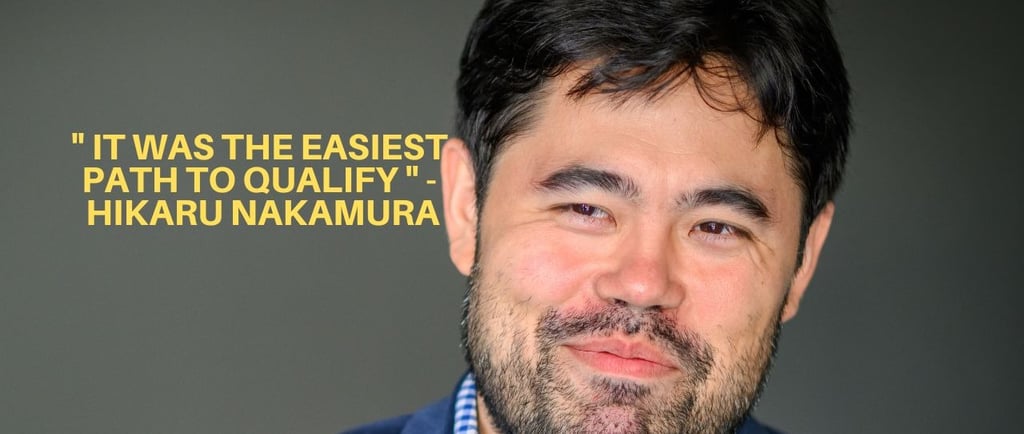
" It was the easiest path to qualify " -Hikaru Nakamura
In this interview with FIDE, grandmaster Hikaru Nakamura discusses his preparation and mindset heading into the 2026 FIDE Candidates Tournament. He defends his unconventional qualification path and explains why his extensive online blitz experience and non-traditional coaching staff provide a modern competitive edge. Nakamura emphasises that his secondary career as a content creator reduces the psychological pressure to win, allowing him to play more freely than his opponents. He also reflects on his childhood development, noting how his parents supported his growth without the rigid expectations often found in traditional chess schools. Ultimately, he views his global influence on the next generation of players as a more significant legacy than any specific tournament result.
Charlize Van Zyl: I'm joined by Hikaru Nakamura at the 2026 FIDE Candidates in Cyprus. Hikaru, I want to get straight into this: your qualification, you dubbed the "Mickey Mouse tournaments" as well, and the internet was quite interested in this path that you took. Now that you're sitting here at the Candidates, do you think you've validated that path?
Hikaru Nakamura: I mean, I think there are a couple of things. First of all, it was the easiest path to qualify. Obviously, I could have played a tournament like the US Championship and gotten the games in as well, but at the end of the day, the rules were what they were. I think I was pretty vocal that I think the rules should be changed. If you look at previous Candidates tournaments, there were certain requirements—for example, you had to play either the Grand Swiss or the World Cup. I've said it very clearly in terms of the reason why those randomly vanished; I think everybody already knows, I don't need to state it again. But it was just a matter of taking the easiest path, and so yeah, it's great to be here and really just looking forward to the event.
Charlize Van Zyl: You've also had limited classical over-the-board experience in the last few months. We've got players online like Nepo who was questioning what kind of form you'd be in; how do you feel about your form?
Hikaru Nakamura: I think, first of all, I've been very active in general just playing a lot online. I think that when you're playing actively, whether it's over the board or online, you're playing against very strong competition. I'm not really worried about the form per se. I think that there are definitely certain attitudes towards chess, specifically from the Russian chess community, about the way you should or should not do things, and I think frankly the game of chess is changing.
I think back to my career, and the biggest example is when I started reaching the top 20 or top 30 in the world, I started working with someone who at the time was a little bit below master level, and it's someone that I've been working with more or less ever since. To draw a comparison, another player in this field, Yavok Sinderov, I think his main coach is an IM—definitely not a grandmaster or a household name. The Russian school has always said you have to work with very strong grandmasters and have them as seconds, but I don't really pay much attention to what people say. If people want to be "salty" or unhappy about various ways that players qualify, that's just life and that's just chess.
Charlize Van Zyl: And you're here now, sitting at the Candidates as one of the top seeds. How do you feel about your chances of winning this event?
Hikaru Nakamura: I think as far as this event goes, it's pretty much a random draw; anybody can win. Sometimes you have players who run away with it, like Nepo back in Madrid four years ago, but overall I think usually what it comes down to is the last couple of rounds. If you're in contention, anything can happen. On paper, I think Fabi and I are probably the favorites, but the main thing is just being in a position where in the last two or three rounds, if you can create some chance and win games, that'll be good enough.
Charlize Van Zyl: And what are your thoughts on the field this year? Of course, we have lower-rated players compared to last time, a 100-point difference.
Hikaru Nakamura: Well, I'm a little bit fortunate because one of the players who I think is playing in this field that's perhaps unheralded is Matthias Blue. He's someone who's been very strong online for a long time, so it didn't come as a surprise to me when he qualified. I think he's somewhat underestimated and hasn't had many chances to compete against top players, but when certain players like Anish decided to get very adventurous against him in Wijk aan Zee, they got punished pretty badly. Even if from a rating standpoint he's lower, he's someone who can definitely cause damage.
That being said, I think he's one of the players who, over such a long tournament, is unlikely to win. As I've mentioned many times, there are probably six players who I think have more or less equal chances to win: myself, Fabi, Praggnanandhaa, Anish, Wei Yi, and Sindarov. Then maybe if something goes right, Esipenko could have a chance or Blue if he starts off red-hot. Ratings don't mean a whole lot; you just have to see what happens.
Charlize Van Zyl: On that point, you know, we have these dark horses, and in 2024 you had a negative score against Vidit, losing both games, which was quite an upset. How have you prepared mentally for such a circumstance?
Hikaru Nakamura: Since you mentioned those games, I know some people on the internet act like if I didn't lose those games, I would have won the tournament. Every game has a certain outcome, and if certain results don't occur, the entire tournament would be completely different. I don't really think about it that way. In 2024, I took my chances when I had them. The first game against Vidit was just a disaster, but looking back on the second game specifically, I think it was the right choice the way I played.
As far as this event goes, experience is really important. It seems very unlikely for a player to win on their first try—Gukesh obviously did last time—but in my first time competing in 2016, I went in thinking I was the favorite, had a bad loss early, and the whole tournament was a disaster. In 2024, I also started very badly but was able to pick my moments and had big wins, including against Fabi. Just knowing that anything can happen is important. Being able to deal with adversity and not going insane in the next game is critical, because it takes years to build an empire and one day to destroy it.
Charlize Van Zyl: That's quite interesting. In a round-robin with predefined pairings, do you think the mentality is where the change would happen based on results?
Hikaru Nakamura: To be blunt, opening choices change based on the score. In 2024 against Alireza Firouzja, I took a big chance to keep a game going; if I was on a different score, there's a good chance I would have made the draw instead. For most of us, this is probably the biggest opportunity in our lives, so feeling the pressure and potentially "tilting" when something goes wrong is easy. Having experience is critical to avoid such situations.
Charlize Van Zyl: Hikaru, two years ago you told me that you think your streaming career is more important to you than your classical career. Do you still feel that way?
Hikaru Nakamura: Nothing's going to change my view of that. Perhaps if I were to win this tournament and a World Championship match it could change some things, but in general, the amount of impact I've had reaching so many people over the internet vastly outweighs anything I can accomplish personally at this point. Players like Faustino Oro or Ediz Khan Erdogmus were watching my streams during the pandemic. Having that impact on the next generation or casual fans is far more important than personal accomplishments.
Charlize Van Zyl: Do you think that gives you a competitive edge over players whose literal dream is to be world champion?
Hikaru Nakamura: Drawing on 2016 again, I had these "delusions of grandeur" about winning and what it would mean for my legacy. I was very much in my head, and it had a big impact. Every round I felt like I was running out of time, a feeling of desperation. The irony is, once I didn't have anything left to play for in that tournament, I actually won a couple of games. It's important to keep your emotions in check and be realistic. It probably gives me an edge because they are far more nervous about the outcome than I am, but you still have to play good moves.
Charlize Van Zyl: Let's talk about something more personal. You're a father now; how has that influenced your career?
Hikaru Nakamura: I don't know if being a parent has necessarily changed my outlook from a chess perspective. Broadly speaking, you become aware of the future and look at things through a different lens—thinking 5 or 10 years down the road.
Charlize Van Zyl: And will you be teaching your child chess?
Hikaru Nakamura: Considering both myself and my wife are chess players, it's not something I want my child to do, but if he wants to play, I'm not going to be opposed to it. I'm not going to push him towards it because there are so many things out there. I want him to be exposed to arts, music, or sports and let him choose his course. It's only if he wants to do it.
Charlize Van Zyl: Did your parents push you, or did you find a love of the game yourself?
Hikaru Nakamura: I was very lucky because I come from a family of chess players. My brother was a master-level player and my stepfather had been teaching for a long time, so it wasn't something I was pushed towards. At the start, both my parents were kind of hesitant, but once I got going they just let me play. Neither of my parents expected me to become a world-class player.
However, there were certain decisions they took that pushed me—like traveling from a young age for IM norms in Hungary. My parents took me out of public school, and if not for that, there's literally zero chance that I'd be a professional chess player. But it was never something where there was pressure; they were always just rooting for me.
Charlize Van Zyl: What would young Hikaru think of you now?
Hikaru Nakamura: I think we'd both be very happy. The younger me would be happy with the impact I've had, and the older me is happy with how far I was able to go. When I was young, I improved a lot by playing blitz on the internet, which at the time was really frowned upon as a way to train. Now, 25 years later, it's widely accepted. I didn't really think about making a career from chess until I won the US Championship in about 2004 or 2005.
Charlize Van Zyl: Final question: where did the nickname "HBO" come from?
Hikaru Nakamura: I think that's of my own doing. It started in the early 2000s when Gmail was invite-only. I got an invite from a friend connected to Google at the time and came up with that. I still have that email, though I don't use it much.
Charlize Van Zyl: Well, thank you so much, Hikaru, and good luck for your Candidates.
Hikaru Nakamura: Thank you.
